Constructivism ART
~originated in Russia
~beginning in 1919
~a great effect on modern art movements of the 20th century
~major impacts upon architecture, graphic and industrial design, theatre, film, dance, fashion and to some extent music

- Lyubov Popova (April 24, 1889 – May 25, 1924)
- born in Ivanovskoe
- was a Russian avant-garde artist (Cubist,Suprematist and Constructivist), painter and designer
ARTWORKS OF THE ARTIST:
Air man space (1912)
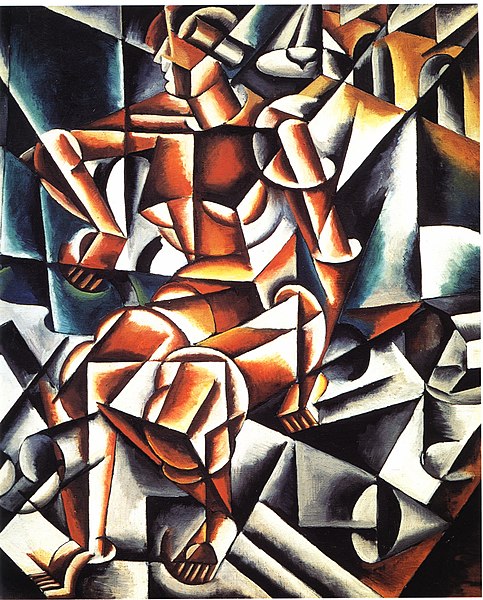
Painterly Architectonics (1916-18)

Sketch for Portrait (1915)


Elements
@Space
~the area provided for a particular purpose
~have two dimensions (length and width)
Space includes the background, foreground and middle ground. Space refers to the distances or areas around, between or within components of a piece
~Two types of space: positive and negative space
@Color
~By the way light reflects off a surface, or in colored light sourcess
~Color and particularly contrasting color is also used to draw the attention to a particular part of the image
~There are primary colors, secondary colors, and tertiary colors
@Shape
~A shape is defined as an area that stands out from the space next to or around it due to a defined or implied boundary, or because of differences of value, color, or texture.
~ Shapes can also show perspective by overlapping.
~ Shapes in house decor and interior design can be used to add interest, style, theme to a design like a door.
@Texture
~The quality of a surface or the way any work of art is represented.
~Lines and shading can be used to create different textures as well.
@Form
~Created by the forming of two or more shapes or as three-dimensional shape (cube, pyramid, sphere, etc.).
~Enhanced by tone, texture and colour.
~Considered three-dimensional showing height, width and depth.
@Value
~Value, or tone, refers to the use of light and dark, shade and highlight, in an artwork.
~Black-and-white photography depends entirely on value to define its subjects
~Directly related to contrast.
@Line
~Defined as a mark that spans a distance between two points (or the path of a moving point), taking any form along the way.
~Line pertains to the use of various marks, outlines and implied lines in artwork and design, most often used to define shape in two-dimensional work.
~Implied line is the path that the viewer's eye takes as it follows shapes, colours, and form along a path, but may not be continuous or physically connected, such as the line created by a dancer's arms, torso, and legs when performing an arabesque.
Principles
Movement
~Movement shows actions, or alternatively, the path the viewer's eye follows throughout an artwork.
~Caused by using elements under the rules of the principles in picture to give the feeling of action and to guide the viewer's eyes throughout the artwork.
Emphasis
~Emphasis is the point of attraction in a piece of art that draws the viewers eye.
Unity
~Unity is the wholeness that is achieved through the effective use of the elements and principles of art.
~The arrangement of elements and principles to create a feeling of completeness.
Harmony
~Harmony is achieved in a body of work by using similar elements throughout the work, harmony gives an uncomplicated look to a piece of artwork.
@Space
~the area provided for a particular purpose
~have two dimensions (length and width)
Space includes the background, foreground and middle ground. Space refers to the distances or areas around, between or within components of a piece
~Two types of space: positive and negative space
@Color
~By the way light reflects off a surface, or in colored light sourcess
~Color and particularly contrasting color is also used to draw the attention to a particular part of the image
~There are primary colors, secondary colors, and tertiary colors
@Shape
~A shape is defined as an area that stands out from the space next to or around it due to a defined or implied boundary, or because of differences of value, color, or texture.
~ Shapes can also show perspective by overlapping.
~ Shapes in house decor and interior design can be used to add interest, style, theme to a design like a door.
@Texture
~The quality of a surface or the way any work of art is represented.
~Lines and shading can be used to create different textures as well.
@Form
~Created by the forming of two or more shapes or as three-dimensional shape (cube, pyramid, sphere, etc.).
~Enhanced by tone, texture and colour.
~Considered three-dimensional showing height, width and depth.
@Value
~Value, or tone, refers to the use of light and dark, shade and highlight, in an artwork.
~Black-and-white photography depends entirely on value to define its subjects
~Directly related to contrast.
@Line
~Defined as a mark that spans a distance between two points (or the path of a moving point), taking any form along the way.
~Line pertains to the use of various marks, outlines and implied lines in artwork and design, most often used to define shape in two-dimensional work.
~Implied line is the path that the viewer's eye takes as it follows shapes, colours, and form along a path, but may not be continuous or physically connected, such as the line created by a dancer's arms, torso, and legs when performing an arabesque.
Principles
Movement
~Movement shows actions, or alternatively, the path the viewer's eye follows throughout an artwork.
~Caused by using elements under the rules of the principles in picture to give the feeling of action and to guide the viewer's eyes throughout the artwork.
Emphasis
~Emphasis is the point of attraction in a piece of art that draws the viewers eye.
Unity
~Unity is the wholeness that is achieved through the effective use of the elements and principles of art.
~The arrangement of elements and principles to create a feeling of completeness.
Harmony
~Harmony is achieved in a body of work by using similar elements throughout the work, harmony gives an uncomplicated look to a piece of artwork.
~Color Harmony or Color Theory is also considered a principle through the application of the design element of color.
Variety
~Variety = alternation~The quality or state of having different forms or types.
~The differences which give a design visual and conceptual interest: notably use of contrast, emphasis, difference in size and color.


